Pittsburgh went against the grain by selecting Louisville catcher Henry Davis with the No. 1 overall pick, while Texas took Vanderbilt pitcher Jack Leiter at No. 2.
Welcome to the 2021 MLB Draft.
While this year doesn’t feature a once-in-a-lifetime talent to headline the event, there’s still plenty of intrigue around the draft. There’s a trio of exciting high school shortstops, a pair of popular Vanderbilt pitchers and some powerful college hitters with plenty of upside. This draft is also the first since its debut in 1965 it takes place outside of June.
We'll provide live updates throughout the night as teams (minus the Houston Astros, in their second and final year of lost first- and second-round picks as punishment for sign stealing) make first-round selections. Names and analysis will be updated as picks are made.
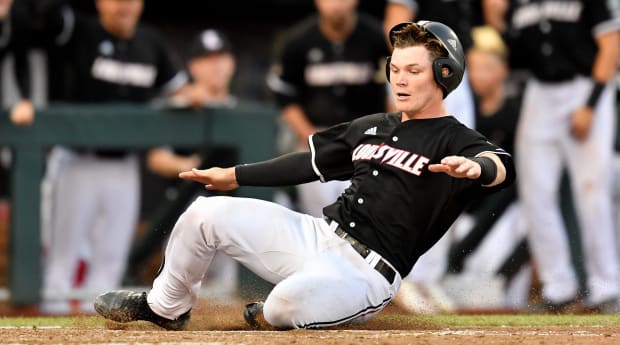
No. 1 Pittsburgh Pirates: Henry Davis, C, Louisville
Davis is the best college bat in the draft, slashing .370/.482/.663 with 15 homers and 48 RBIs in his most recent season with Louisville. A composed and powerful hitter, Davis has a keen eye for pitches and can make hard contact or reel it in to draw walks (he had six more walks than strikeouts throughout his college career). Davis’s offensive strengths make up for some of his inconsistencies behind the plate, where he’s occasionally struggled to handle quality pitching. He improved in 2021 and should be able to stay behind the plate within the Pirates’s farm system.
Many mock drafts anticipated Pittsburgh would lean toward one of the high school shortstops—Marcelo Mayer and Jordan Lawlar got plenty of buzz—but the Pirates elected for the experience of Davis, a player who wasn’t drafted out of high school despite being Perfect Game’s top catcher from the state of New York in 2018.
No. 2 Texas Rangers: Jack Leiter, RHP, Vanderbilt
Leiter is considered by many to be the best college pitcher in the draft. He soared to star status in his final year at Vanderbilt, finishing 11-4 with a 2.13 ERA, 0.845 WHIP, 179 strikeouts (tied with Vandy teammate Kumar Rocker for most in the NCAA) and an appearance in the College World Series finals. Leiter’s fastball is elite and sits at 90-95 mph with a vertical break that consistently tricks hitters. His 6-foot-1 stature could be considered small for a starter, but he’s building strength that should help him climb up the minor ranks. He also has major league pitching in his blood—his father, Al Leiter, uncle and cousin all pitched in the majors.
Leiter had been linked to the Boston Red Sox ahead of the draft but was picked up by the Rangers. The selection tracks with Texas’s past three first-round picks—all seasoned college players.
No. 3 Detroit Tigers: Jackson Jobe, RHP, Heritage Hall HS (Okla.)
Jobe is ahead of the curve for a high school pitcher. The 18-year-old Gatorade Oklahoma high school player of the year has, perhaps, the best slider in the draft, a quick arm and marked improvement in his secondary pitches, upgrading his low-80s changeup and refining his upper-70s curveball. Jobe’s athleticism and maturity on the mound set a solid foundation for him to develop further in the Tigers’ minor league system.
No. 4 Boston Red Sox: Marcelo Mayer, SS, Eastlake HS (Calif.)
Mayer, 18, leads the pack of elite high school shortstops anticipated to go early this year. In his senior year at California’s Eastlake High School, Mayer emerged as one of the draft’s top hitters (batting .392 with 14 homers and 45 RBIs as a senior) and defenders. Mayer’s size (6'3") and power have drawn comparisons to the Dodgers’ Corey Seager, though Mayer will likely spend a few years becoming acclimated to high-level pitching in the Red Sox’s minor league system before he’s ready for a major league debut.
No. 5 Baltimore Orioles: Colton Cowser, OF, Sam Houston
Cowser’s left-handed bat is one of the strongest from this year’s college group. He slashed .374/.490/.680 with 75 hits, 16 home runs and 54 RBIs in 2021, growing on a three-year trend of improvement at Sam Houston. The Southland Conference player of the year demonstrated success during his time as a member of the U.S. collegiate national team, when he batted .438 in six games against Cuba in the 2019 and earned the MVP title. Uncertainty lingers around his power potential as well as his ability playing center field, but honing in on his instinct and continuing to polish his bat should help him climb up with the Orioles.
No. 6 Arizona Diamondbacks:
No. 7 Kansas City Royals:
No. 8 Colorado Rockies:
No. 9 Los Angeles Angels:
No. 10 New York Mets:
No. 11 Washington Nationals:
No. 12 Seattle Mariners:
No. 13 Philadelphia Phillies:
No. 14 San Francisco Giants:
No. 15 Milwaukee Brewers:
No. 16 Miami Marlins:
No. 17 Cincinnati Reds:
No. 18 St. Louis Cardinals:
No. 19 Toronto Blue Jays:
No. 20 New York Yankees:
No. 21 Chicago Cubs:
No. 22 Chicago White Sox:
No. 23 Cleveland Indians:
No. 24 Atlanta Braves:
No. 25 Oakland Athletics:
No. 26 Minnesota Twins:
No. 27 San Diego Padres:
No. 28 Tampa Bay Rays:
No. 29 Los Angeles Dodgers:
No. 30 Cincinnati Reds — Compensation Pick:
Competitive Balance Round A:
No. 31 Miami Marlins:
No. 32 Detroit Tigers:
No. 33 Milwaukee Brewers:
No. 34 Tampa Bay Rays:
No. 35 Cincinnati Reds:
No. 36 Minnesota Twins:
More MLB Coverage:
• Three Burning Questions as the Trade Deadline Looms
• The Charmed Season: Revisiting Derek Jeter’s Origin Story
• It's Time for the Next Chapter in Cleveland's Title Chase
• Forecasting Rookie of the Year Contenders Halfway Through the Season